
The virtuous economic cycle
The Spring Economic Update gets it backwards

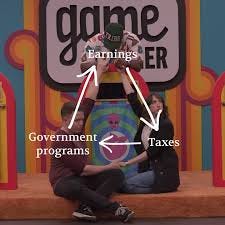
Sam says, always remember the virtuous economic cycle. Someone needs to remind the federal government.
If you’re a fan of improv games, queer representation, and companies that pay people for their work, maybe you’ve also discovered Dropout TV. It’s run by Sam Reich, the son of former Secretary of Labor Robert Reich. That means that sometimes he drops in little nuggets that challenge the assumptions of the neo-liberal status quo.
The simplified economic model in the image above suggests that tax revenue contributes to government programs, and when government programs enhance earnings, those higher earnings result in higher tax revenue … a virtuous cycle that contributes to sustainable economic growth and broad prosperity.
Mark Carney’s ‘values’ are outdated
Since taking office Mark Carney’s government has cut billions in federal taxes, and billions in federal spending - exactly the opposite of this model. Aside from cutting approximately 40,000 federal public service jobs and a variety of department-delivered programs and transfers, the growth of the national childcare program has stalled before it has been fully implemented, and $4.3 billion in bilateral health care agreements on long-term care, home care, and mental health addictions will not be renewed when they expire in 2027 and 2028. There is some new spending on infrastructure, but most of that is focused on privatization. (Yes, there’s also the defence spending, the impact of which could vary widely depending on whether they increase wages and build housing for members of the military - or if they buy big ticket items built somewhere else.)
Based on the actions of this government - cutting taxes and cutting programs while subsidizing the building of infrastructure for the private sector - Mark Carney is stuck in the disproven economic theories of the 90’s and early 2000’s. He hasn’t gone as far as Grover Norquist did when he said "I don't want to abolish government. I simply want to reduce it to the size where I can drag it into the bathroom and drown it in the bathtub." - but his actions are consistent with that brand of fiscal conservatism that sees government as inherently wasteful, and the private sector as the only engine of the economy.
A study by London School of Economics economists David Hope and Julian Limberg, published in December 2020, analyzed more than 50 years of tax cuts for the richest in 18 of the major European and North American OECD countries and found very conclusively that cutting taxes doesn’t grow the economy. Tax cuts didn’t stimulate growth or create jobs in any of these countries; they just increased inequality. This effect happened because there was an increase in ‘rent-seeking’ behaviour by the very rich - they bargained more aggressively to increase their share of the pie without creating more wealth. As a result - the rich got richer, and the rest of us got left behind.
We could have nice things that are good for the economy
A really good illustration of a government program that does fit the model of a virtuous economic cycle is public childcare. Investments that increase the availability of affordable childcare directly create jobs for childcare workers, allow parents to return to the workforce and earn more money, and have other economic spin-offs from the goods and services that the expanded childcare providers purchase, and the increased spending from higher earnings.
When Justin Trudeau’s government initially introduced the program, their estimates forecast that once it was fully in place, childcare would pay for itself via increased tax revenues. A more recent academic study from Kevin Milligan, Michael Maker and Jonathan Gruber at UBC estimates that between 75% and 117% of the cost of the program ends up being returned to governments through higher income taxes and lower social assistance and employment insurance costs.
In Budget 2021, the federal government announced investments of $27 billion dollars over 5 years, 2021-22 - 2025-26, a little more than $5 billion per year.
Jim Stanford estimates that by 2024, this investment in childcare directly added 40,000 jobs in the early learning and child care sector across Canada, increased the average weekly earnings for workers in the sector, and increased the labour force participation of core age women (25-54) by about 100,000 workers. Adding up direct and indirect impacts to the economy, the federal childcare program is estimated to have added $32 billion to Canada’s GDP in 2024 alone, and returned billions of dollars back to federal and provincial governments through increased income and sales tax.
Not only that, but the growth in the early learning and childcare sector helped keep Canada out of a recession at the end of 2023, at the same time that lower childcare prices helped lower inflation (lower childcare costs reduced annual CPI in 2023 by 0.2 points).
Manitoba has seen the biggest growth in the labour force participation of mothers - an 8% increase in 2024 compared to 2019. This is exactly what happened in Quebec when they introduced their childcare program - before the program was introduced in 1997 the employment rate for mothers in Quebec was 59.9% - below the Canadian average of 62.3%. By 2019, that statistic had risen to 78.3% for Quebec mothers - much faster than it rose for the rest of Canada.
The Canada-wide Early Learning and Child Care plan was a significant federal financial and policy commitment that has made a dramatic difference in people’s lives - making childcare affordable and improving wages for workers. But it’s not finished. There aren’t enough spaces for everyone that needs one, too many of the spaces are in the for-profit sector, and retention of qualified workers is a challenge - one that needs to be addressed with improvements to wages, pensions, and benefits. The program is not at a maintenance stage - it’s still in progress. Stalling federal funding now risks undercutting the principles that will make it successful in the long run.
But the part that concerns me the most, is that policy makers don’t seem to have understood that this program isn’t a drain on the system - it’s a foundational part of building a more equitable, stable, and vibrant economy. This is the engine of the economy that will make Canada strong and deliver wealth into the future … not another fund that subsidizes private enterprise as they cannabilize what public infrastructure that we have left.
So, let’s all do what we can to remind Mark Carney - always remember the virtuous economic cycle. The children (and parents) are counting on you.
Great article! I totally support this government investment circular economy rationale. It works for citizens.
Cynically, I suspected that the same Liberals who campaigned against national childcare in 2015 and then suddenly rediscovered the issue just in time to campaign on it in 2021 may have been playing politics with no sincere intentions of actually implementing a program. Even just as a straight capitalist economic investment, it pays so much more dividends than tripling military spending (much less tax cuts for tech giants).